Archive for the ‘Leadership’ Category


When Leaders Corrupt their Culture

Posted on: March 14th, 2012 by Hayim Herring
Mori Tower

From "Not Quite a Photographr" on Flickr

If Greg Smith, a Goldman Sachs executive who resigned today in an Op-Ed in the New York Times, is correct, his former employer is corrupt to the core. Its leaders have violated the trust of their clients and traded professional integrity for profits. Smith voiced commonly held beliefs about big bankers. What made his critique so devastating is that it came from an insider.

One of Smith’s roles was to recruit students for Goldman Sachs’s coveted summer internships. One of his more telling comments was: “I knew it was time to leave when I realized I could no longer look students in the eye and tell them what a great place this was to work.” Clearly, he couldn’t look at himself in the mirror, either.

In this week’s Torah reading, Vayakhel-Pekudei (Exodus 35:1-40:38), Moses calls the Israelites to build the mishkan, the traveling tabernacle, and the people give generously to accomplish the goal. In last week’s reading, Ki Tissa (30:11-34:35), the people also contribute abundantly, but their donations go toward building the golden calf.

Why do they give for a noble cause in this week’s reading and a debased caused in last week’s reading? The answer can be reduced to one word: leadership. Aaron allowed himself to be corrupted by the people, but Moses had the strength to keep them focused on higher aspirations. That’s what genuine leaders do.

As Smith reminds us, the integrity of any organization or enterprise always depends upon those leading it. That is an inevitable truth.


Your Record is Now Permanent

Posted on: February 16th, 2012 by Hayim Herring
Footprint in the sand

Photo by manuel cazzaniga on Fotopedia

The death of Whitney Houston is a very sad event. From scenes of her singing in a gospel choir as a teen to recent television interviews-so much of her life has been laid bare in public. There is an incredible amount about her that is permanently available to the world.

This intense week of coverage made me reconsider a phrase from the Rosh ha-Shanah Musaf prayer: “Under Your gaze, all hidden things come to light…For nothing is forgotten before the throne of Your glory, and nothing is hidden from Your eyes” (Musaf Amidah, Koren Sacks Rosh ha-Shanah Mahzor). This is what we say about God, but now we, too, have the technology to make so much of our lives available to the public for anyone to view.

(more…)

The Difference between a Leader and a Demagogue

Posted on: January 26th, 2012 by Hayim Herring
SJ2638 : Somewhere Over The Rainbow by Rod Trevaskus

© Copyright Rod Trevaskus and licensed for reuse under the Creative Commons License.

Imagine two people in a room, sitting in chairs facing one another. One wall of the room is painted black and has no windows. The opposite wall is painted yellow, has multicolored artwork hanging from it and several windows. The two people who are sitting opposite one another are asked to describe the room. The first person proceeds to describe a brightly painted room, with colorful artwork and a view to the outside through several windows. The second person is able to describe the room in three words, “dark without windows.” They each look at each other with a puzzled look. Are they both sitting in the same room? (more…)

When Leaders Become Distant, Expect Rebellion

Posted on: December 21st, 2011 by Hayim Herring
Lighting Hanukkah Candles

From Sarah Ross on flickr

In America, where Chanukah is often perceived as the “Jewish Christmas,” there’s a tendency to universalize the message of the holiday. You’ve probably heard Chanukah referred to as a victory for religious freedom, with the few (Maccabees) defeating the many (Syrian Hellenists). While it’s actually not quite that simple, there is a legitimately universal insight that we can draw from Chanukah: when leaders become distant, expect popular rebellion.

Chanukah was every bit as much of a civil war as it was a war of the Jews against a Syrian oppressor. The religious leadership in Jerusalem had become corrupt and violated essential tenets of Jewish faith. They had become elites, who believed themselves entitled to make any changes they desired. They no longer believed that they were accountable to God or to the people who had entrusted them with their spiritual well being. They became oblivious to the reality on the ground.

Does this story sound familiar? It does seem to be universal today. The global “Occupy” protest movement is just one modern manifestation. Social protests against the recent Russian elections are another.  The fighting between the Egyptian military and civilians, and the brutal dictatorship of Bashar al-Assad in Syria against a people that is no longer willing to accept authoritarian rule are yet other dark examples.

But these modern day rebellions have a new feature that did not exist in the time of the Maccabees. Today, when leaders act corruptly or brutally, their actions are likely to be quickly broadcast worldwide via social media networks. Social media contribute to transparency in leadership, increasing the likelihood of protest when leaders stray from their responsibilities. If you’re in a position of leadership, Chanukah offers a perfect opportunity to reflect on how close or distant you are to the people that you are entrusted to lead.

Are You Satisfied?

Posted on: December 15th, 2011 by Hayim Herring
Oyster drawing

From "Suttonhoo" on flickr

If you’re in a position of leadership, and you feel satisfied for long stretches of time, then you may not really be leading. While leaders know how to celebrate achievements, they are always looking ahead to the next unresolved issue or new opportunity. Good leaders are genuinely positive about the work that they do and inspire others with their optimism. But, they are not satisfied with the status quo for too long.

According to one commentator on this week’s Torah reading, Vayeshev (Gen. 37:1-40:23), the Biblical patriarch, Jacob, is rebuked by God for trying to settle down. As Rashi writes on Gen. 37:2: “This righteous person seeks to dwell in tranquility. Said the Holy One, ‘What is prepared for the righteous in the world to come is not sufficient for them, but they seek [also] to dwell in tranquility in this world!’”

What’s the argument behind this comment? Jacob, as God’s designated heir to the covenant and leader of the Jewish people, will have ultimate, eternal tranquility in the afterlife. But in this life, his unending task is to be God’s instrument through which the covenant is fulfilled, and that requires Jacob to have a mentality of movement and not stasis, or settling down.

At its core, then, leadership means thinking and working toward the next challenge, even when you find yourself thinking: “Wouldn’t it be nice to settle down a bit?” So, ask yourself, are you satisfied with your achievements? If so, by all means celebrate it, but even as you’re doing so, focus on the next issue that is bothering you. Just as oysters turn irritants into pearls, there is another gem of an idea just waiting for your creative leadership.

B’shalom,

Rabbi Hayim Herring

If You Lived in Israel, How Would America Look to You?

Posted on: December 8th, 2011 by Hayim Herring
magnifying glass

From Fox-Photography_VE on flickr

Imagine that you’re a Jewish Israeli citizen who was born, raised and is living in Israel. Because you have family members living in the United States and you care about them, you follow the news in America with some regularity.

Over the past several years, despite changes in presidential administrations, you’ve become increasingly worried for your American mishpacha. Americans seem to have one foreign policy approach: wage war (either overtly or covertly); and one response to domestic issues: cut taxes. Public bigotry seems to be tolerated, if the rate at which gays and lesbians are demonized is any indication. Individual liberties have been curtailed because of the Patriot Act and social protest movements don’t seem to be tolerated well.

Many of the Republican candidates seeking the presidency seem to have been named after the cartoon character Dopey (one of the dwarfs in Snow White) and while President Obama would make a great orator-in- chief, he certainly doesn’t know about leadership. And at times he seems ambivalent about your own country: Israel. While you never planned to live in the United States, you’ve visited it periodically. You used to admire it, but now, you’re not so sure….America seems morally and politically adrift. It is starting to remind you of other broken democracies in the West.

You can substitute some of the facts and names, but that’s how many American Jews increasingly feel about Israel. (See blogger and columnist, Jeffrey Goldberg, for three big concerns that American Jews have about Israel in an article entitled, How Israel Can Stop Alienating American Jews.) At a time when there’s an external international effort to undermine Israel’s right to exist as a Jewish state, some Israeli leaders seem hell bent on making political choices that are internally destructive. Internal and external dynamics then feed off of one another, further fueling these crises.

So what should Jewish leaders who love Israel do? First, leaders have to be honest. That means while expressing their love, they also have to name the issues that trouble them. Second, they have to provide context and nuance for discussions. If they can accomplish these two acts, then they create a condition for a discussion where divergent points of view are heard. They can model that being clear in your own positions doesn’t negate the need to hear other points of view. Finally, leaders need to remember and remind others of the adage that, “no one ever built a statue to a critic.” If you’re ready to criticize, then be ready to get to work to improve the situation.

B’shalom,

Rabbi Hayim Herring

The Fear of Falling Up

Posted on: November 29th, 2011 by Hayim Herring
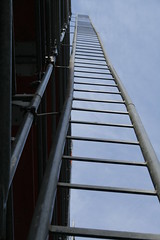
Ladder to the Sky

Flickr: jepoirrier

Did you ever suspect that some leaders fear success more than they do failure?  If they aim high and hit their target once, how can they possibly replicate the last success next time? And especially if they do, won’t people start to have ever higher expectations of them?

Because of that fear, these kinds of leaders learn to play it safe or take mild risks at most. As a result, they never reach their own potential and even worse, they don’t help a community develop its capacity for greatness. I’m not sure who coined the phrase, “the fear of falling up,” but it certainly captures this attitude toward the apprehension of the consequences of success.

In one midrash (rabbinic commentary) on a famous scene in this week’s Torah portion (Vayetze, Genesis 28:10-32:3), we find an acknowledgment of this very fear. The Biblical partriarch, Jacob, envisions angels ascending and descending a ladder to heaven. According to this midrash, God beckons Jacob to climb the ladder, but Jacob declines. He reasons that he will eventually have to descend, so why risk the climb? He does not consider that although he will have to descend, who is to say that he won’t be able to climb to the top again?

Jewish leaders-and indeed all leaders-can follow two basic paths. They can be content to reach for the “low hanging fruit” and play it safe. Or, they can exercise genuine leadership, and “reach for the stars,” acknowledging that they will only reach them some of the time. What kind of leader do you aspire to be?

B’shalom,

Rabbi Hayim Herring

How do Leaders Look?

Posted on: November 3rd, 2011 by Hayim Herring

rear view mirrorDid you ever try to drive without a rear view mirror? What about driving with one of your side view mirrors sadly dangling from the doorframe? Or, have you had the experience of driving with an annoying crack in your front windshield or with your rear windshield covered with fog?

Over the years, I’ve had all of these experiences. (I remember, especially, the time when a certain family member dislodged the driver’s side view mirror while backing out of the garage, and then proceeded to blow a hole in the tire while driving in reverse over it—not recommended!)

None of these problems with windshields and mirrors are beneficial and, while they can be repaired, they are often costly and dangerous. They create unsafe driving conditions because while a good driver spends the majority of time looking ahead, he or she also has to look to either side and observe what’s coming up from behind.

And that’s what leadership is: spending some time understanding your organization’s past, being aware of what other organizations on either side of you are doing now, and primarily leading confidently and safely to the next destination.

If you’re a leader, ask yourself:

  1. How much energy do you spend mired in your organization’s past?
  2. How much time do you worry about what others to the right or left of you are saying?
  3. How much effort do you give to achieving your next big goal?

Within the Jewish community, we need fewer leaders who spend time reliving a past that is not returning. We need fewer leaders who move too timidly because they are concerned about what those around them will say if they take a new route. We need leaders who, while sensitive to hindsight and peripheral vision, know that their primary task is to look ahead and give confidence to those whom they lead to do so as well.

We are the Biblical Abraham and Sarah’s spiritual heirs, whom God commanded lekh lekhah–journey forth. We can draw upon their courage and confidently move ahead into the future, even if we don’t have complete knowledge of where we are going. That’s what faith is ultimately about. Like Abraham, authentic leaders look ahead.

B’shalom,

Rabbi Hayim Herring

What Non-Profit Leaders Can Learn from Steve Jobs

Posted on: August 29th, 2011 by Hayim Herring

Apple co-founder and former CEO Steve Jobs is an undisputed genius in the field of technology and computing. Someone with his brilliance is exceptionally rare. And while we can’t be Steve Jobs, non-profit leaders can still learn much from him about some fundamentals of leadership.

Innate genius is a gift. But leadership is something that you can cultivate in yourself and others.

Introducing Hayim’s Blog (Formerly “Tools for Shuls”) + Special Offer!

Posted on: July 25th, 2011 by Hayim Herring

Image courtesy of yourdictionary.com

I’m incredibly excited to launch my new blog!  I placed blogging on hold so that I could focus more attention on my book and building my business.  And, I came to recognize that my Tools for Shuls blog was now too narrowly focused.

So much has changed in the Jewish world since I first started blogging a couple of years ago! The economic recession’s impact on the Jewish community, the fractured relationship between parts of the American Jewish community and Israel, the level of civil discussion within our own Jewish community-just to name a few!  “Tools for Shuls” inaccurately suggested by its title that some quick fixes in synagogues could address these issues, so resetting my blog, while launching the new website for the Herring Consulting Network, seemed timely.

If you’ve been a reader of this blog, what can you expect to see that’s different? And for those who are new, what is this blog all about? The general focus is on developing leaders for the synagogue, Jewish communal and non-profit world who want to create the future that they hope to see, instead of waiting for the future to happen to them. For me, that’s a good working definition of leaders: people who dream big about tomorrow and create their tomorrows today.

You can expect two posts approximately every 10 days. One will relate to aspects of leadership. The other will ask you to comment on trends and issues related to your synagogue or organization. I envision the blog as a space for collaboration, where people can exchange ideas and experiences about leading organizations, and where they can pose questions to a diverse audience. So let’s start the conversation by asking:

Special limited offer:
All those who comment on this week’s question will be entered into a drawing for a free consulting session!*  There will be three different levels awarded:  One three-hour session, one two-hour session, and one one-hour session.  The drawing will take place on August 17, 2011, and winners will be notified via email.  So go ahead, share your responses by commenting below and you might win!

I look forward to resuming the conversation with you.

B’shalom,

Rabbi Hayim Herring


*Consulting sessions will be given via conference call and will be scheduled according to Rabbi Herring’s availability.  Sessions are non-transferable and not redeemable for any cash value.